Saturday, September 7, 2013

The Lost Heir

Wings of Fire #2: The Lost Heir by Tui T. Sutherland
Scholastic Press - January 1, 2013
336 pages

The lost heir to the SeaWing throne is going home at last...
She can't believe it's finally happening. Tsunami and her fellow dragonets of destiny are journeying under the water to the great SeaWing kingdom. Stolen as an egg from the royal hatchery, Tsunami is eager to meet her future subjects and reunite with her mother, Queen Coral.
But Tsunami's triumphant return doesn't go quite the way she imagined. Queen Coral welcomes her with open wings, but a mysterious assassin has been killing off the queen's heirs for years, and Tsunami may be the next target. The dragonets came to the SeaWings for protection, but this ocean hides secrets, betrayal--and perhaps even death.

Okay, I don't read much middle grade fiction anymore (with the exception of Warriors and Survivors, but I've spent so much time with those cats that I don't expect to give up anytime soon). Young adult and adult fiction? Check, check, check. But I was engrossed by this series due to its being written by one of the Erin Hunters. Plus, it was about dragons.

It's easily better than almost all of the middle grade fiction out there. It doesn't minimize violence or plot because it's written for a younger audience, and all of the characters are believable. While they seemed like somewhat charicatures in book one, that was before I realized that each book would have insight into the world of each dragonet so that you get to understand them and their motives much better. I also love the broken prophecy plot; the prophecy wanted a SkyWing, but they got a RainWing instead, the SandWing has stunted growth and the NightWing doesn't have secret powers.

The underwater kingdom seemed real to me for that setting, which was a big thing for me. Tsunami seems annoying at first, but she grows into her own over the course of the book and becomes a more sympathetic protagonist.

A couple minor gripes: the language didn't seem like what dragons would be saying. I know that they're young, but they probably wouldn't use the same language as human teenagers. Also, the awkward capitalization of dragon names is a little annoying. That's all that I can think of.

Grade: A-

Monday, September 2, 2013

Fire Bringer

Fire Bringer by David Clement-Davies
MacMillan UK - October 8, 1999
498 pages

Young buck Rannock was born on the night his father was murdered and into a herd of deer where hunger for power has gradually whittled away all that is true and good. He knows that he must escape to survive. Chased by stags, with their fearsome antlers sharpened for the kill, he begins a treacherous journey into the unknown, and ahead of him lies a shocking and formidable search for truth and goodwill in the shadow of the Great Mountain.
One day he will have to return to his home and face his destiny among the deer to fulfill the prophecy that has persistently given them hope: that one day a fawn will be born with the mark of an oak leaf on his forehead and that fawn's courage will lead all the deer to freedom. Filled with passion and a darkness that gradually, through Rannoch's courage in the face of adversity, lifts to reveal an overwhelming feeling of light, Fire Bringer is a tremendous, spirited story that takes the reader deep into the hearts and minds of its characters as they fight for their right to live in peace.

I tried to read The Sight by David Clement-Davies about a year and a half ago and I needed to stop. I found this one recently and decided to give it a shot because I thought it must amount to a slimmer version with the bigger font, shorter standing, and slightly fewer pages.

I was pleasantly surprised. Fire Bringer took a lot of cliche elements (a prophecy, a great evil, a suspicious birthmark that lets everyone know that you're The Chosen One), but it didn't seem that horrible to me. It wasn't that amazing either; it was just good. Some of the chapters were misnomers, as what was covered in that chapter was only in the first few pages, but that's only a minor gripe.

One good thing is that Clement-Davies isn't afraid of killing deer off. In most books, you know that nobody is really in danger because the author would never even think of killing them off; George R. R. Martin, Erin Hunter, and now David Clement-Davies will let anyone die who you think just HAS to be safe.

I reiterate: the story reuses many old literature tropes, and though it doesn't turn them on their heads, it isn't bad either. The result is something familiar and bland, but it's better than new and terrible.

Grade: B

Saturday, August 24, 2013

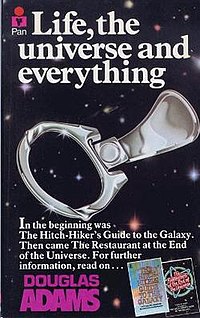
Life, the Universe and Everything

Life, the Universe and Everything by Douglas Adams
Pan Books - 1982
160 pages

The unhappy inhabitants of planet Krikkit are sick of looking at the night sky above their heads--so they plan to destroy it. The universe, that is. Now only five individuals stand between the killer robots of Krikkit and their goal of total annihilation.
They are Arthur Dent, a mild-mannered space and time traveler who tries to learn how to fly by throwing himself at the ground and missing; Ford Prefect, his best friend, who decides to go insane to see if he likes it; Slartibartfast, the indomitable vice president of the Campaign for Real Time, who travels in a ship powered by irrational behavior; Zaphod Beeblebrox, the two-headed, three-armed ex-president of the galaxy; and Trillian, the space cadet who is torn between a persistent thunder god and a very depressed Beeblebrox.
How will it all end? Will it end? Only this stalwart crew knows as they try to avert "universal" Armageddon and save life as we know it--and don't know it!

This one is different than the other two. The plot is about Armageddon by the robots of Krikkit from the beginning to end. It ambles in the middle, but ultimately it sticks with one plot the whole way through, which saves a lot of trouble.

The book took me only a couple of days to read, but it makes it difficult to review. Unlike most series that have wild ups and downs (The Last Werewolf trilogy), the Hitchhiker's "trilogy" stays more and more consistent.

Grade: A-

Thursday, August 15, 2013

Talulla Rising

Talulla Rising by Glen Duncan
Canongate Books - April 5, 2012
425 pages

(DO NOT READ ANY MORE UNLESS YOU HAVE READ OR DO NOT INTEND TO READ THE LAST WEREWOLF. THIS IS FOR YOUR OWN SAFETY.)

Talulla Demetriou is the last living werewolf. And she is pregnant. Pursued by enemies and racked by the need to kill, she flees to a remote Alaskan hunting lodge to have her child in secret. There, with her infant son in her arms, it looks like the worst is over. Until the door bursts open - and she discovers that the worst is only just beginning...Talulla is plunged into a race against time to save her son. Tormented by guilt and fueled by rage, she is pursued by deadly forces - including (rumor has it) the oldest living vampire on earth. Hopeless odds. Unless, of course, a mother's love for her child turns out to be the deadliest force of all...

This was better than The Last Werewolf. Okay, this was actually way better than The Last Werewolf, but that doesn't take much. It includes none of the main things that I griped about in the previous article; no more sexism, better writing, and only one viewpoint in the entire book.

I love the emergence of the female werewolf that doesn't kill herself after her first kill, because that's a resourceful, brave woman that isn't afraid to take what's hers. Not to mention, she actually has compassion for her fellow humans (or at least some of them), unlike Jake's constant hatred of everyone else that isn't the one female werewolf he happens to come across.

That being said, there's some disturbing stuff in Talulla, and not of the violence variety. In particular is a scene between Talulla and one of her captors, Devaz. I will be scrubbing my brain to rid myself of that entire chapter.

The ending sets it up for a third entry, which will probably focus on (MAJOR SPOILER!)the pack that Talulla has joined(SPOILER END). So we'll see how it goes in that one, because Jake's story was bad and Talulla's good.

Grade: B+

Tuesday, August 13, 2013

Lexicon

Lexicon by Max Barry
Penguin - June 18, 2013
390 pages

At an exclusive school somewhere outside of Arlington, Virginia, students aren't taught history, geography, or mathematics--at least not in the usual ways. Instead, they are taught to persuade. Here the art of coercion has been raised to a science .Students harness the hidden power of language to manipulate the mind and learn to break down individuals by psychographic markers in order to take control of their thoughts. The very best will graduate as "poets" adept wielders of language who belong to a nameless organization that is as influential as it is secretive.
Whip-smart orphan Emily Ruff is making a living running a three-card Monte game on the streets of San Francisco when she attracts the attention of the organization's recruiters. She is flown across the country for the school's strange and rigorous entrance exams, where, once admitted, she will be taught the fundamentals of persuasion by Bronte, Eliot, and Lowell--who have adopted the names of famous poets to conceal their true identities. For in the organization, nothing is more dangerous than revealing who you are: Poets must never expose their feelings lest they be manipulated. Emily becomes the school's most talented prodigy until she makes a catastrophic mistake: She falls in love.
Meanwhile, a seemingly innocent man named Wil Jamieson is brutally ambushed by two strange men in an airport bathroom. Although he has no recollection of anything they claim he's done, it turns out Wil is the key to a secret war between rival factions of poets and is quickly caught in their increasingly deadly crossfire. Pursued relentlessly by people with powers he can barely comprehend and protected by the very man who first attacked him, Wil discovers that everything he thought he knew about his past was fiction. In order to survive, must journey to the toxically decimated town of Broken Hill, Australia, to discover who he is and why an entire town was blown off the map.
As the two narratives converge, the shocking work of the poets is fully revealed, the body count rises, and the world crashes toward a Tower of Babel event which would leave all language meaningless. Max Barry's most spellbinding and ambitious novel yet, Lexicon is a brilliant thriller that explores language, power, identity, and our capacity to love--whatever the cost.


And the answer is no, I couldn't have shortened that anymore, so I'll write a short review. This was a good book.

Okay, not that short. I'm not a big fan of mystery/thriller/suspense books, but this one was fun. You had to focus a lot on it and keep looking back to make sure you knew what was going on, but it turned out to be great. The Emily story begins several years before the Wil one, if it takes you a while to figure that one out, by the way.

The one thing that I didn't like was that Kathleen Raine was made out to be working with Virginia Woolf at the beginning of the story, but it turns out that she has pretty much nothing to do with it. I think maybe an editor should've caught that.

And while this was a good book, it's not something I'm going to be recommending to people like crazy because it didn't feel like a "me" book. I certainly enjoyed it while it was happening, but it's not something that I would go crazy over if it was made into a movie (which is good, because I think it's pretty much unfilmable without giving away all the secrets).

Grade: A-

Wednesday, August 7, 2013

The Shining Girls

The Shining Girls by Lauren Beukes
Random House Struik - 15 April 2013
375 pages

THE GIRL WHO WOULDN'T DIE HUNTS THE KILLER WHO SHOULDN'T EXIST.
Harper Curtis is a killer who stepped out of the past. Kirby Mazrachi is the girl who was never meant to have a future.
Kirby is the last shining girl, one of the bright young women burning with potential whose lives Harper is destined to snuff out after he stumbles upon a House in Depression-era Chicago that opens on to other times.
At the urging of the House, Harper inserts himself into the lives of the shining girls, waiting for the perfect moment to strike. He's the ultimate hunter, vanishing into another time after each murder, untraceable--until one of his victims survives.
Determined to bring her would-be killer to justice, Kirby joins the Chicago Sun-Times to work with the ex-homicide reporter, Dan Velasquez, who covers her case. Soon Kirby finds herself closing in on the impossible truth...

Define "soon".

Because if you mean the first 84.4% of the book, then you're sorely mistaken. That part of the book is Harper killing various girls who only get one chapter, Kirby talking to murder victims' families and supposed killers trying to figure something out, and Dan getting a huge, overly creepy crush on Kirby. And yes, I actually did the math to figure out that 84.5% through the book is when Kirby finally figures out that Harper comes from the future. After that, everything wraps itself up in a pretty little ribbon all at the end, just like Where'd You Go, Bernadette.

Most of the book was spent either with one-shot chapters in the point of view of one of Harper's victims or of Harper OR Kirby doing God knows what about serial killer nonsense. Did I repeat that? Not exactly, with a few different words? I'm sorry, I guess I'm like Beukes and have to show you the same thing over and over with a couple of variations.

The characters were all one-dimensional things that didn't really seem to have any life. I've seen boxes of cereal that were less cardboard than Harper, Kirby, and everyone else.

Maybe I kept reading this book because I thought that something would happen, or maybe because the chapters were so short I thought that maybe I could just read a few and then stop. Or maybe I just wanted to prove I could slog through this book. No matter what, I was a fool.

Grade: F

Red Moon

Red Moon by Benjamin Percy
Grand Central Publishing - May 7, 2013
533 pages

They live among us.
They are our neighbors, our mothers, our lovers.
They change.
When government agents kick down Claire Forrester's front door and murder her parents, Claire realizes just how different she is. Patrick Gamble was nothing special until the day he got on a plane and hours later stepped off of it, the only passenger alive, a hero. Chase Williams has sworn to protect the people of the United States from the menace in their midst, but he is becoming the very thing he has promised to destroy. So far, the threat has been controlled by laws and violence and drugs. But the night of the red moon is coming, when an unrecognizable world will emerge...and the battle for humanity will begin.

(Spoiler level: MAJOR!!!)

I really hope they're making a sequel to this.

Not because I liked it.

Because there was no...freaking...ENDING!!!

You know how in the end of Inception, Leonardo DiCaprio spins the top and it cuts out before it lands so you don't know whether he's dreaming or not and you can make that up for yourself and it's open-ended, but in a cool way?

Not this. Not this at all. Instead it leaves all of its characters stranded. Patrick got bitten, but he's given a vaccine that will "help" him, but I'm pretty sure that the shot is supposed to prevent you from getting infected before you're bitten, and once you're bitten there's nothing you can do about it. The president is limping around in the forest with a bloody foot, and Miriam is slinking around in the woods with people after her and...GRR!!!

I'm also pretty sure that Buffalo died three times, and then the same grammar mistake happens again and again of putting an object pronoun after an incomplete comparison (e.g. "more than him" when it should be "more than he".)

Ugh. It was some fun in the beginning, but it was too long not to have an ending.

Grade: D

Tuesday, August 6, 2013

The Restaurant at the End of the Universe

The Restaurant at the End of the Universe by Douglas Adams
Pan Books - January 1, 1980
208 pages

Facing annihilation at the hands of the warlike Vogons is a curious time to have a craving for tea. It could only happen to the cosmically displaced Arthur Dent and his curious comrades in arms as they hurtle across space powered by pure improbability and desperately in search of a place to eat.
Among Arthur's motley shipmates are Ford Prefect, a longtime friend and expert contributor to the Hitchhiker's Guide to the Galaxy; Zaphod Beeblebrox, the three-armed, two-headed ex-president of the galaxy; Tricia McMillan, a fellow Earth refugee who's gone native (her name is Trillian now); and Marvin, the moody android who suffers nothing and no one very gladly. Their destination? The ultimate hotspot for an evening of apocalyptic entertainment and fine dining, where the food (literally) speaks for itself.

This is the second book out of five in the Hitchhiker "trilogy" written by Adams himself. Fortunately, I liked it just as much as the first one. It starts with a laugh as the entire computer system on the ship shuts down because it needs to figure out how to make tea, or "the taste of dried leaves boiled in water with milk squirted out of a cow."

This one's plot was a little less coherent than its predecessors while it was going on, but I think that it tied together better at the end and more of an ending, which is more than I can say for the first book. However, that means that it wasn't set up particularly well for a third book, which is bad considering there are five books written by Adams and one more by Eoin Colfer.

This installment is less about Arthur and Ford than it is Zaphod and Marvin; while Zaphod wasn't exactly my favorite character in Hitchhiker's, Marvin was one of the greatest robots, if not one of the greatest speculative fiction characters, I have ever seen. Once again he uses his pessimism to kill off other technology, this time by angering a tank into shooting around the floor it's standing on and falling through to the ground, where it breaks.

Zaphod also comes more into his own in this part, although he's still not anywhere near being my favorite character. Here's to hoping Ford and Marvin go on an adventure in book 3!

Grade: A-

Needful Things

Needful Things by Stephen King
Viking - October 1991
690 pages

Leland Gaunt opens up a new shop in Castle Rock called Needful Things. Anyone who enters his store finds the object of his or her lifelong dreams and desires: a prized baseball card, a healing amulet. In addition to a token payment, Gaunt requests that each person perform a little "deed", usually a seemingly-innocent prank played on someone else from town. These practical jokes cascade out of control and soon the entire town is doing battle with itself. Only Sheriff Alan Pangborn suspects that Gaunt is behind the population's increasingly violent behavior.

(Minor spoilers ahead)

Unlike The Tommyknockers, which I still can't believe is only 558 pages, this book is worth its 690. Although it's filled with the usual King puffery of long tangents and characters that don't mean anything, it was still all rather entertaining.

One thing that I wish had been played on more was in the end, where the town turns against each other completely and all of the objects turn into something useless, like Brian Rusk's Sandy Koufax card turning into a useless rookie and Deputy Clutterbuck's fishing pole turning into a bamboo rod. Actually, those are the only two examples I can think of, which is probably why I'm saying it could have been done more.

Apart from that, it was all good fun. I particularly like the ending and hope that King sets a future work up in Paradise Falls, Iowa. That's all I'm going to say.

Grade: A-

Tuesday, July 16, 2013

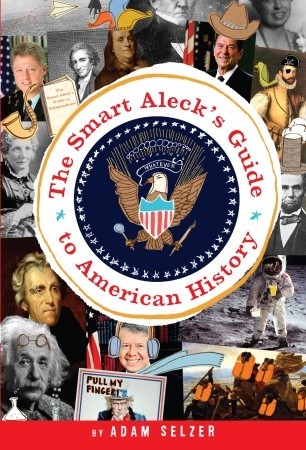
The Smart Aleck's Guide to American History

The Smart Aleck's Guide to American History by Adam Selzer
Delacorte Press - December 22, 2009
336 pages

Do you know America? No, I mean, do you REALLY know America? Would you recognize John Adams in a lineup? Can you identify any presidents between Lincoln and Roosevelt?
Hmm. I thought so.
Well, you really need this book.
Not only will it improve your sorry historical knowledge, it will crack you up, and give you material to throw your teachers off-balance for entire class periods. Identify their lies! Point out their half-truths! And possibly, just possibly, gain some extra credit for yourself.

For the record, the presidents between Lincoln and Roosevelt are Andrew Johnson, Ulysses S. Grant, Rutherford B. Hayes, James Garfield, Chester Alan Arthur, Grover Cleveland, Benjamin Harrison, Grover Cleveland again, and William McKinley. I knew that before even opening the book; I've actually memorized the presidential order; it just takes me a second to think of the number. Usually it's in some relation to the assassinated ones (16, 20, 25, and 35, but that's if you count Cleveland twice).

I found out about this book when I was doing some research into the poem written by Charles Guiteau (the assassin of Garfield; see Destiny of the Republic) right before his execution, "I am Going to the Lordy". The book is presented in textbook style, so there are questions after every chapter; there was an "Extra Credit" section where you had to say what Guiteau's poem sucked more than, such as being a capitalist at Leon Czolgosz's dinner parties.

I was immediately sucked into the book within minutes of opening it; the pictures and sidebars especially are humorous, as they used only public domain pictures. This resulted in a picture of four dots being an overhead shot of the Beatles, and James Monroe as a substitution for Marilyn Monroe. It also teaches you actual history, such as how Victoria Woodhull tried to run for president when women couldn't vote, she wasn't even thirty-five, and she was in prison on election day.

It's not even just for kids or teenagers; anyone can enjoy it, even if they know all of the history. For example, I already knew about Charlie Guiteau, but the sidebar on him was still great because of the take that they used (not unlike my own when I'm describing the assassination to people).

Grade: A

The Teleportation Accident

The Teleportation Accident by Ned Beauman
Sceptre - July 19, 2012
357 pages

HISTORY HAPPENED WHILE YOU WERE HUNGOVER
When you haven't had sex in a long time, it feels like the worst thing that is happening to anyone anywhere. When you're living in Germany in the 1930s, it probably isn't. But that's no consolation to Egon Loesser, whose carnal misfortunes will push him from the experimental theatres of Berlin to the absinthe bars of Paris to the physics laboratories of Los Angeles, trying all the while to solve two mysteries: whether it was really a deal with Satan that claimed the life of his hero, the great Renaissance stage designer Adriano Lavicini; and why a handsome, clever, charming, modest guy like himself can't, just once in a while, get himself laid. From the author of the acclaimed Boxer, Beetle comes a historical novel that doesn't know what year it is, a noir novel that turns all the lights on, a romance novel that arrives drunk to dinner, a science fiction novel that can't remember what "isotope" means, a stunningly inventive, exceptionally funny, dangerously unsteady and (largely) coherent novel about sex, violence, space, time, and how the best way to deal with history is to ignore it.
LET'S HOPE THE PARTY WAS WORTH IT

You know those summaries of books where you really wonder if whoever was tasked with doing that truly read the book or if they just skimmed it and decided to come up with a wild hook to get people into the novel? Well, I think that's what happened here. Maybe thirty pages are devoted to the Lavicini mystery, and it isn't even about a deal with Satan, It's about whether the "Teleportation Accident" of 1679 was actually an accident.

So, the book. Not one of my favorites. I think it might have been my fault, because I was thinking to myself one day that I had read so many good books, and I would just love to rant and rant about how horrible a book is. Unfortunately, I haven't gotten something that horrendous. In fact, I've gotten stuff I've forced myself to finish, felt bad about finishing, but didn't want to go crazy ranting about it like I had Mockingbird.

I simply didn't care about any of the characters, which was good considering how many of them popped up and then disappeared. In addition, the last few chapters skip about ten years, and you're expected to understand everything that happened in those ten years. The plot isn't a clear, defined one, much like The Dead Zone; instead it aimlessly wanders around, pausing at times to poke at something that might become sort of a story before the author gets bored with it and throws it away. He even grew bored with the era of the 1930's/40's, so near the end he just skipped a decade per chapter and expected you to know what was going on.

I don't know why I forced myself to finish this. Maybe I thought that it would get better? Whatever the answer is, it didn't get better. There's no plot, just some meandering stories that happen to feature an unlikable protagonist and his interactions with unlikable people. I would give it an F, but then I remind myself of Mockingbird.

Grade: D-

Thursday, July 11, 2013

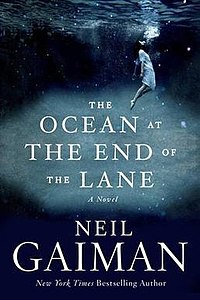
The Ocean at the End of the Lane

The Ocean at the End of the Lane by Neil Gaiman
William Morrow and Company - June 18, 2013
192 pages

Sussex, England. A middle-aged man returns to his childhood home to attend a funeral. Although the house he lived in is long gone, he is drawn to the farm at the end of the road, where, when he was seven, he encountered a most remarkable girl, Lettie Hempstock, and her mother and grandmother. He hasn't thought of Lettie in decades, and yet as he sits by the pond (a pond that she'd claimed was an ocean) behind the ramshackle old farmhouse, the unremembered past comes flooding back. It is a past too strange, too frightening, too dangerous to have happened to anyone, let alone a small boy.

A lot of the people who have been giving this book bad reviews say that it is just a puffed-up short story that was "expanded" by the author just to illicit more money out of his readers. My complaints are different.

I like Neil Gaiman, I really do: I like Coraline and The Sandman and The Last Temptation, a sort of comic collaboration with Alice Cooper and Michael Zulli. I think he's a great author. This one I wouldn't recommend to a Gaiman beginner who wanted to see how he writes (much as I probably wouldn't recommend The Dead Zone to a Stephen King beginner).

Gaiman tries much too hard in this one to be confusing in a good way, where you're not always supposed to understand what's going on, but you still read it because it's fun to go along. This wasn't the case. There are so many layers of nonsense and craziness that it's impossible to find anything fun in it.

The characters are all pretty lackluster; Gaiman decided it would be "edgy" not to give his protagonist a name, which has already been done in Fight Club, Invisible Man, and Rebecca. I swear, if this were a normal-sized book, I probably wouldn't have gotten through it.

Grade: D 

Tuesday, July 9, 2013

Chomp

Chomp by Carl Hiaasen
Alfred A. Knopf - March 27, 2012
304 pages

Wahoo Cray lives in a zoo. His father is an animal wrangler, so he's grown up with all types of creatures in his backyard. The critters he can handle, but his father is another story.
When his father takes a job for a reality TV show called Expedition Survival!, Wahoo has to do a bit of wrangling to keep his father from killing the star, boneheaded Derek Badger, before the shoot is over. Things keep getting more and more complicated as Derek insists on using wild animals in his stunts. Then there's Wahoo's new shadow Tuna, a girl with an abusive father who needs somewhere to hide out.
It's anyone's guess who will actually survive Expedition Survival!...

I had to cut a paragraph out of that description because it pretty much gives away a chunk of the story due to the type of lousy publicity that Hiaasen has that decides to spill out over half the novel in a 3 1/2 paragraph description.

I love Carl Hiaasen, especially his YA books about the Everglades: Hoot, Flush, and Scat. I've been waiting more than a few years for the next one, and I can tell you that Chomp sufficiently meets my expectations. Instead of being about saving a species, like burrowing owls or Florida panthers, this is about a  broke wildlife wrangler and his son who take a job for a "reality" show to pay off their debt.

In the usual Hiaasen way, Chomp is enough to make you laugh out loud on several occasions and is filled with nearly caricature characters, but it also has elements that I don't remember seeing in previous YA Hiaasen Everglades books: actual suspense and danger where you legitimately worry about the lives of the characters.

Ladies and gentlemen, what can I say? Hail...to...Hiaasen! (If you don't get that reference, brush up on your controversial musicals)

Grade: A

The Catswold Portal

The Catswold Portal by Shirley Rousseau Murphy
Roc Hardcover - April 7, 1992
405 pages

There is a door in an artist's garden: an elaborate carved passageway into a realm ruled by a dark sorceress queen. There entities strange and wondrous roam the Netherworld--yet none as astonishing as the shape-shifting Catswold...
Raised by the old witch Mag, Melissa discovers a perilous secret. She has more than one form--human girl and magical cat--and once inhabited two worlds. And it is her destiny to return to a mystic realm of wonder and terror, to do battle for her people's liberation and the crown that is rightfully hers.
A man beset by tragedy, painter Braden West is intrigued by the calico cat who has charmed her way into his studio. But his "guest" is more than she seems, and Braden's very existence will be radically altered as he follows Melissa from the Hell Pit into the dread perils of an evil ruling court, thrust into the heart of a magical conflict with more at stake than he could have possibly imagined.

(Spoiler level: Moderate)

About a few hours after I closed the book, I was about to sit down to eat dinner when a scary thought hit me.


Melissa...was...seventeen. Braden was, what, twice her age? All those scenes. Eeeeeeeeeew.

Anyway, on to the rest of the review. This is supposed to be a prequel of sorts to the Joe Grey Mysteries by Shirley Rousseau Murphy, which I also enjoy but don't review here because I started reading them so long ago. It's technically a prequel in that the Catswolders are supposed to explain how Joe Grey and Dulcie can talk. It's not a prequel in that it was actually written before Joe Grey, and the word "prequel" is a term for a book that is written after another but takes place before. It's also not in that it doesn't take place where Joe Grey does and has none of the same characters.

There are two protagonists here: Melissa, who is Catswold (meaning that she's a cat shapeshifter) and living in secret for seventeen years. Then there's Braden, who is just a human trying to live a normal life after his wife got hit by a car. Melissa is perilously boring, so I kept anticipating another Braden chapter; unfortunately, they were few and far between.

The antagonist, an evil queen, is also pretty lackluster. As a whole, in fact, the fantasy Underworld is pretty basic. Fortunately, Murphy keeps things moving pretty fast. Sometimes too fast, but anything to distract you from how regular the world is.

Grade: B-

Monday, June 24, 2013

TransAtlantic

TransAtlantic by Colum McCann
Random House - June 4, 2013
320 pages

Newfoundland, 1919. Two aviators--Jack Alcock and Arthur Brown--set course for Ireland as they attempt the first nonstop flight across the Atlantic Ocean, placing their trust in a modified bomber to heal the wounds of the Great War.
Dublin, 1845 and '46. On an international lecture tour in support of his subversive autobiography, Frederick Douglass finds the Irish people sympathetic to the abolitionist cause--despite the fact that, as famine ravages the countryside, the poor suffer from hardships that are astonishing even to the American slave.
New York, 1998. Leaving behind a young wife and newborn child, Senator George Mitchell departs from Belfast, where it has fallen to him, the son of an Irish-American father and a Lebanese mother, to shepherd Northern Ireland's notoriously bitter and volatile peace talks to an uncertain conclusion.
These three iconic crossings are connected by a series of remarkable women whose personal stories are caught up in the swells of history. Beginning with Irish housemaid Lily Duggan, who crosses paths with Frederick Douglass, the novel follows her daughter and granddaughter, Emily and Lottie, and culminates in the present-day story of Hannah Carson, in whom all the hopes and failures of previous generations live on.

(Spoiler level: Minor/moderate)

Whew! That was about the longest summary I've ever had to find. I tried to condense it as much as possible, but then I wouldn't get the whole story.

So, I picked this book up because I saw two things that interested me: Ireland and strong women. There are about four stories shown, and so it's really a motley semi-anthology.

Lily Duggan/Frederick Douglass: I really enjoyed this one. It may have been my favorite part of the entire thing. I liked Frederick Douglass's descriptions of the potato famine and his interactions with the various Irish people. Lily Duggan was barely mentioned in the first part except when she ran off to America after meeting Douglass. I'm not sure I would have enjoyed page upon page of description of a seventeen-year-old Irish maid going about her daily business, though.

Emily Ehrlich/Alcock and Brown: This one I had more mixed feelings about. I enjoyed the broken family/single mom aspect of Emily and her daughter Lottie, but later Emily marries one of the aviators in something I found a little too hard to believe. The Emily story had the main part of TransAtlantic, which was a letter that Alcock and Brown were supposed to deliver from Newfoundland to Ireland. I preferred the first part of this story to the second.

Lottie Carson (nee Ehrlich)/George Mitchell: I wasn't as big a fan of this one. I think it was because I wasn't much a fan of George Mitchell. Well, he at least wasn't that great in what I read. He could be a perfectly nice man in real life. In the story, though, he has a much younger wife and a newborn that he said he was so sad to leave behind. Lottie, on the other hand, I enjoyed. Good books should make you feel something, and I generally felt bad for her when she tried to play tennis but was much too old.

Hannah Carson: Ah, now the interesting part of the Hannah Carson story, as I'm sure you've noticed, is that she meets no one famous. Hannah has no living family now that her mother Lottie and son have both died, the former of old age and the latter of The Troubles. Her story mainly revolves around whether or not to open the letter that Alcock and Brown carried across the Atlantic. While certainly interesting, it didn't captivate my attention like the others.

Overall comment: One of my biggest pet peeves in any novel is when they try to do something creative with the dialogue. In some books they only put one quotation mark to either side instead of two. In Mockingbird, which I detested for other reasons as well, people talked with italics. In TransAtlantic, people talk with an emdash followed by straight text. No quotation marks or anything. I am not a fan.

Grade: B+

Knight or Knave

Knight or Knave by Andre Norton and Sasha Miller
Tor Fantasy - June 2, 2001
320 pages

Times are changing in Rendel. The old King is dead, and the foolish Prince Florian has assumed the throne. Florian's mother, Queen Ysa of the House of Yew, still controls the land from behind the scenes, but her job grows more difficult every day. Her unworthy, headstrong son is harder to control than her husband was, and she must spend more time than ever masking her own movements. Her husband's illegitimate daughter Ashen, heir to the nearly dead House of Ash, still causes trouble by her very existence, and must never be given an opening to the throne. The barbarian Sea-Rover clan presents problems from the edge of the Bog, Ysa's newest magical ally has been exposed as a traitor, and nothing is going as Ysa had planned.
And the still unknown yet encroaching threat from the North continues to grow.
Through births and deaths, marriages and duels, love and betrayal, magic and force, the four houses of Rendel can only survive by the strength of their unity--but is unity possible in such a court of intrigue as this one?

When I was in middle school, we had this thing called the "class story". Every person in the class wrote the next chapter of it. You got some people who knew how to write and would make everything smoothly connect while adding their own personal style and throwing in a twist. Then there were the people who made Jackie Chan come in and nuke everyone except a rabid squirrel. (I'm serious, that was seventh grade.) Knight or Knave was kind of like that on a smaller scale.

You get parts that help move the story forward and you get parts that bring it to a screeching halt. You get parts with characters that have good attributes, flaws, motivation, and ideas, and you get parts with characters that are completely black-and-white. All of the black-and-white characters, though, are shallow. You get parts that are great and you get parts that are...not great.

Now, after dedicated research on both of the authors, I'm going to choose to believe that the better parts were written by Andre Norton and the worse parts were written by Sasha Miller. That being said, I may possibly be continuing the series out of interest, which is what happened with Knight or Knave after To The King a Daughter, but I certainly won't be devouring it any time soon.

Grade: B-/C+ (I'm in the middle on this one)

Wednesday, June 12, 2013

Black Beauty

Black Beauty by Anna Sewell
Jarrold & Sons - November 24, 1877
281 pages

"We call them dumb animals, and so they are, for they cannot tell us how they feel, but they do not suffer less because they have no words."

When his beloved owners are forced to sell him, Black Beauty leaves his life as a young, carefree colt behind him and embarks on a working life of misery. Cruelly treated by his new masters, Anna Sewell rails against animal mistreatment in this poignant tale of a horse whose spirit can not be broken.

Can I express to you how much I love this novel adequately? I don't think so, but I'm certainly going to try.

You may have noticed, loyal blog readers, that this book has been in my "Currently reading" section for quite a while. It's not because I disliked Black Beauty, as the above paragraph clearly shows, but rather because I got bogged down reading several other books.

As a self-described "3/4 animal-rights activist", I wholeheartedly agree with the particular messages that Sewell is trying to send. While I eat poultry and keep a pet, I am fully against the mistreatment of horses, especially by using a whip to drive a horse past its breaking point. Even though I already felt this way before, Black Beauty is enough to change the majority of people.

Grade: A

Tuesday, June 11, 2013

The Last Werewolf

The Last Werewolf by Glen Duncan
Canongate Press - March 1, 2011
293 pages

Meet Jake. A bit on the elderly side (he turns 201 in March), but you'd never suspect it. Jake is a werewolf, and after the unfortunate and violent death of his one contemporary, he is now the last of his species. Although he is physically healthy, Jake is deeply distraught and lonely to the point where he is actually contemplating suicide--even if it means terminating a legend thousands of years old. It would seem to be easy enough for him to end everything. But for very different reasons there are two dangerous groups pursuing him who will stop at nothing to keep him alive. In Jake, Glen Duncan has given us a werewolf for the twenty-first century--a man whose deeds can only be described as monstrous but who is in some magical way deeply human.

(Spoiler rate: Minor)

First, the sexism. There are fewer female werewolves (called "Shes") than males (well, I suppose that since Jake is the last werewolf and he's a man, there would be fewer Shes). I thought that there was going to be some completely scientific explanation for it, such as the metabolism of women doesn't hold up with the werewolf virus or something like that. Nope! It's because women are so much more sensitive. They'll make their first kill and stay up all night crying about it, then swallow a silver earring to kill themselves. Great.

Second, the actual writing. First of all, there are some downright confusing sentences where nothing makes sense. Either a word or proper punctuation was missing to make it simply wrong. Second, I counted multiple instances in which there was a period missing. Third, there was the use of language. I have nothing against obscenities in literature when it advances the plot or is used for characterization purposes. I get it, people talk like that. It doesn't mean that every time that you come to a human body part you have to use one of the "terrible c-words" to describe it.

Third and finally (and this is more of a minor aggression than the sexism and writing above), about three-quarters into the novel, maybe more, the book switches viewpoints. While we were hearing all of Jake's thoughts up until then. For the next part, we hear about Talulla, who I'm just going to say is someone very special to all characters involved. No major spoilers here. I'm fine with multiple viewpoints, having handled everything in A Game of Thrones, but the problem is that if you are in a first-person novel and switch the viewpoint, you have to tell the reader right away. I was about two pages in when I realized that it was no longer Jake's thoughts. Everything made sense again.

There is a sequel, however, to The Last Werewolf. It's called Talulla Rising. Since it's about Talulla, it solves the sexism and (I hope) the viewpoint problems. Talulla is also a much more sympathetic protagonist than Jake is. No matter how much of a train wreck The Last Werewolf may have been, it was still an exciting romp, and with a change of personality, the sequel will be on my list.

Grade: C-

The Perks of Being a Wallflower

The Perks of Being a Wallflower by Stephen Chbosky
MTV Books/Pocket Books - February 1, 1999
256/224 pages

This is the story of what it's like to grow up in high school. More intimate than a diary, Charlie's letters are singular and unique, hilarious and devastating. We may not know where he lives. We may not know to whom he is writing. All we know is the world he shares. Caught between trying to live his life and trying to run from it puts him on a strange course through uncharted territory. The world of first dates and mixed tapes, family dramas and new friends. The world of sex, drugs, and The Rocky Horror Picture Show, when all one requires is that perfect song on that perfect drive to feel infinite.

Through Charlie, Stephen Chbosky has created a deeply affecting coming-of-age story, a powerful novel that will spirit you back to those wild and poignant roller coaster days known as growing up.

(Spoiler level: Minor/moderate)

I cheated. I watched the movie first and then decided to read the book. I tell you right now that they are both awesome and rather close. Of course, it's pretty obvious that they would be close, as Stephen Chbosky wrote and directed the movie version. In this case, it actually helps you move through the book.

This is another epistolary novel that I didn't slug through, joining the ranks of Where'd You Go, Bernadette and, in a distant time, Carrie. Charlie addresses letters to someone he just calls "Friend" about his time at school. He proceeds to make friends with seniors and only seniors and then scares all of his fellow freshmen, as well as the sophomores and juniors. As a result, he will live out the next three years of high school completely and totally miserable, as he has no hope of making friends except with younger kids, but the kids in his class will probably tell them ahead of time to "Watch out for crazy Charlie! He punched a kid in the face and completely blacked out!"

The book is frequently cited as being on various banned or controversial book lists because of the content that it deals with, and trust me on this case, it certainly does deal with a lot. Suicide, abortion, abuse, homophobia, the list goes on and on. Some complaints have revolved around how the book deals with all of these, but I think that it handles them pretty well.

The only complaint that I have about the book is what Charlie knows and doesn't know. He appears to be relatively clueless about sex, but he knows much more about drugs, smoking, alcohol, etc. (For those of you who read the book, I'm choosing to ignore the pot brownie part, where it's obvious that he doesn't know what he's eating; other times he knows about marijuana, acid, etc.) He has also read an otherworldly amount of books, but yet, once again, clueless about sex. I'm guessing he hasn't read Lolita.

Grade: A-

Where'd You Go, Bernadette

Where'd You Go, Bernadette by Maria Semple
Little, Brown and Company - August 1, 2012
335 pages

Bernadette Fox is notorious. To her Microsoft-guru husband, she's a fearlessly opinionated partner; to fellow private-school mothers in Seattle, she's a disgrace; to design mavens, she's a revolutionary architect, and to 15-year-old be, she is a best friend and, simply, Mom.
Then Bernadette disappears. It began when Bee aced her report card and claimed her family reward: a family trip to Antarctica. But Bernadette's intensifying allergy to Seattle--and people in general--has made her so agoraphobic that a virtual assistant in India now runs her most basic errands. A trip to the end of the earth is problematic.
To find her mother, Bee compiles email messages, official documents, secret correspondence--creating a compulsively readable and touching novel about misplaced genius and a mother and daughter's role in an obscene world.

(Spoiler level: Major in the third paragraph)

Let's start with the news praise: OMG this book is totally hilarious and full of heart with lots of crazy twists and amazing, unforgettable characters and everyone should buy this because it's so totally amazing! A+++ (okay, hopefully no magazine actually said that, but you get everything that's being said about the book)

Now for my praise: The book is completely fast-moving. It's an epistolary novel consisting mostly of emails between Bernadette and her virtual assistant in India as well as Bernadette's nemesis Aubrey Griffin and her friend Soo-Lin Segal. While I don't normally enjoy epistolary novels, I found this one to be quick. There are also little breaks of straight information. Bee and Bernadette are fully-developed characters with dreams, hopes, etc.

And finally my problems: First and foremost, the ending seems completely rushed. Everything was wrapped up way too soon. It especially felt wrong in that Semple makes it sound like everything's going to be okay when the circumstances say that in no real situation it would be okay. If you ran away from home and your husband is the baby daddy of a coworker, things are not going to be okay. Period. End of story. Second, everyone says that this book is hilarious, but there were very few points that I found truly funny. Third, Bee and her friend Kennedy are 15-year-olds in eighth grade. I understand that Bee would be a year behind, because she was born with heart defects that led to multiple surgeries. But Kennedy is totally normal and therefore should be thirteen turning fourteen, not fourteen turning fifteen. There is no explanation as to why she would be a year behind.

In a nutshell: Everyone adores this book. It's fast with a couple of remarkable characters, but the ending feels incomplete, it's not as funny as everyone says, and there's no explanation as to why eighth graders are fifteen.

Grade: B