Showing posts with label thriller. Show all posts

Thursday, August 15, 2013

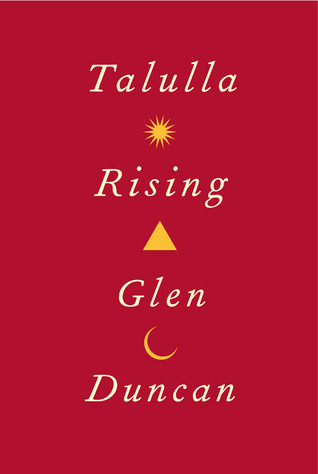
Talulla Rising

Talulla Rising by Glen Duncan
Canongate Books - April 5, 2012
425 pages

(DO NOT READ ANY MORE UNLESS YOU HAVE READ OR DO NOT INTEND TO READ THE LAST WEREWOLF. THIS IS FOR YOUR OWN SAFETY.)

Talulla Demetriou is the last living werewolf. And she is pregnant. Pursued by enemies and racked by the need to kill, she flees to a remote Alaskan hunting lodge to have her child in secret. There, with her infant son in her arms, it looks like the worst is over. Until the door bursts open - and she discovers that the worst is only just beginning...Talulla is plunged into a race against time to save her son. Tormented by guilt and fueled by rage, she is pursued by deadly forces - including (rumor has it) the oldest living vampire on earth. Hopeless odds. Unless, of course, a mother's love for her child turns out to be the deadliest force of all...

This was better than The Last Werewolf. Okay, this was actually way better than The Last Werewolf, but that doesn't take much. It includes none of the main things that I griped about in the previous article; no more sexism, better writing, and only one viewpoint in the entire book.

I love the emergence of the female werewolf that doesn't kill herself after her first kill, because that's a resourceful, brave woman that isn't afraid to take what's hers. Not to mention, she actually has compassion for her fellow humans (or at least some of them), unlike Jake's constant hatred of everyone else that isn't the one female werewolf he happens to come across.

That being said, there's some disturbing stuff in Talulla, and not of the violence variety. In particular is a scene between Talulla and one of her captors, Devaz. I will be scrubbing my brain to rid myself of that entire chapter.

The ending sets it up for a third entry, which will probably focus on (MAJOR SPOILER!)the pack that Talulla has joined(SPOILER END). So we'll see how it goes in that one, because Jake's story was bad and Talulla's good.

Grade: B+

Wednesday, August 7, 2013

The Shining Girls

The Shining Girls by Lauren Beukes
Random House Struik - 15 April 2013
375 pages

THE GIRL WHO WOULDN'T DIE HUNTS THE KILLER WHO SHOULDN'T EXIST.
Harper Curtis is a killer who stepped out of the past. Kirby Mazrachi is the girl who was never meant to have a future.
Kirby is the last shining girl, one of the bright young women burning with potential whose lives Harper is destined to snuff out after he stumbles upon a House in Depression-era Chicago that opens on to other times.
At the urging of the House, Harper inserts himself into the lives of the shining girls, waiting for the perfect moment to strike. He's the ultimate hunter, vanishing into another time after each murder, untraceable--until one of his victims survives.
Determined to bring her would-be killer to justice, Kirby joins the Chicago Sun-Times to work with the ex-homicide reporter, Dan Velasquez, who covers her case. Soon Kirby finds herself closing in on the impossible truth...

Define "soon".

Because if you mean the first 84.4% of the book, then you're sorely mistaken. That part of the book is Harper killing various girls who only get one chapter, Kirby talking to murder victims' families and supposed killers trying to figure something out, and Dan getting a huge, overly creepy crush on Kirby. And yes, I actually did the math to figure out that 84.5% through the book is when Kirby finally figures out that Harper comes from the future. After that, everything wraps itself up in a pretty little ribbon all at the end, just like Where'd You Go, Bernadette.

Most of the book was spent either with one-shot chapters in the point of view of one of Harper's victims or of Harper OR Kirby doing God knows what about serial killer nonsense. Did I repeat that? Not exactly, with a few different words? I'm sorry, I guess I'm like Beukes and have to show you the same thing over and over with a couple of variations.

The characters were all one-dimensional things that didn't really seem to have any life. I've seen boxes of cereal that were less cardboard than Harper, Kirby, and everyone else.

Maybe I kept reading this book because I thought that something would happen, or maybe because the chapters were so short I thought that maybe I could just read a few and then stop. Or maybe I just wanted to prove I could slog through this book. No matter what, I was a fool.

Grade: F

Tuesday, June 11, 2013

The Last Werewolf

The Last Werewolf by Glen Duncan
Canongate Press - March 1, 2011
293 pages

Meet Jake. A bit on the elderly side (he turns 201 in March), but you'd never suspect it. Jake is a werewolf, and after the unfortunate and violent death of his one contemporary, he is now the last of his species. Although he is physically healthy, Jake is deeply distraught and lonely to the point where he is actually contemplating suicide--even if it means terminating a legend thousands of years old. It would seem to be easy enough for him to end everything. But for very different reasons there are two dangerous groups pursuing him who will stop at nothing to keep him alive. In Jake, Glen Duncan has given us a werewolf for the twenty-first century--a man whose deeds can only be described as monstrous but who is in some magical way deeply human.

(Spoiler rate: Minor)

First, the sexism. There are fewer female werewolves (called "Shes") than males (well, I suppose that since Jake is the last werewolf and he's a man, there would be fewer Shes). I thought that there was going to be some completely scientific explanation for it, such as the metabolism of women doesn't hold up with the werewolf virus or something like that. Nope! It's because women are so much more sensitive. They'll make their first kill and stay up all night crying about it, then swallow a silver earring to kill themselves. Great.

Second, the actual writing. First of all, there are some downright confusing sentences where nothing makes sense. Either a word or proper punctuation was missing to make it simply wrong. Second, I counted multiple instances in which there was a period missing. Third, there was the use of language. I have nothing against obscenities in literature when it advances the plot or is used for characterization purposes. I get it, people talk like that. It doesn't mean that every time that you come to a human body part you have to use one of the "terrible c-words" to describe it.

Third and finally (and this is more of a minor aggression than the sexism and writing above), about three-quarters into the novel, maybe more, the book switches viewpoints. While we were hearing all of Jake's thoughts up until then. For the next part, we hear about Talulla, who I'm just going to say is someone very special to all characters involved. No major spoilers here. I'm fine with multiple viewpoints, having handled everything in A Game of Thrones, but the problem is that if you are in a first-person novel and switch the viewpoint, you have to tell the reader right away. I was about two pages in when I realized that it was no longer Jake's thoughts. Everything made sense again.

There is a sequel, however, to The Last Werewolf. It's called Talulla Rising. Since it's about Talulla, it solves the sexism and (I hope) the viewpoint problems. Talulla is also a much more sympathetic protagonist than Jake is. No matter how much of a train wreck The Last Werewolf may have been, it was still an exciting romp, and with a change of personality, the sequel will be on my list.

Grade: C-

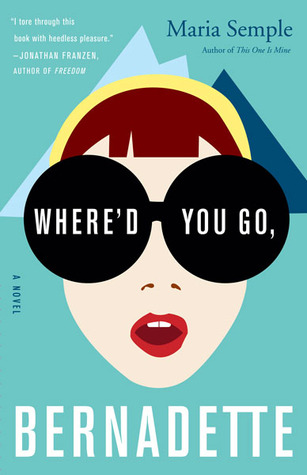
Where'd You Go, Bernadette

Where'd You Go, Bernadette by Maria Semple
Little, Brown and Company - August 1, 2012
335 pages

Bernadette Fox is notorious. To her Microsoft-guru husband, she's a fearlessly opinionated partner; to fellow private-school mothers in Seattle, she's a disgrace; to design mavens, she's a revolutionary architect, and to 15-year-old be, she is a best friend and, simply, Mom.
Then Bernadette disappears. It began when Bee aced her report card and claimed her family reward: a family trip to Antarctica. But Bernadette's intensifying allergy to Seattle--and people in general--has made her so agoraphobic that a virtual assistant in India now runs her most basic errands. A trip to the end of the earth is problematic.
To find her mother, Bee compiles email messages, official documents, secret correspondence--creating a compulsively readable and touching novel about misplaced genius and a mother and daughter's role in an obscene world.

(Spoiler level: Major in the third paragraph)

Let's start with the news praise: OMG this book is totally hilarious and full of heart with lots of crazy twists and amazing, unforgettable characters and everyone should buy this because it's so totally amazing! A+++ (okay, hopefully no magazine actually said that, but you get everything that's being said about the book)

Now for my praise: The book is completely fast-moving. It's an epistolary novel consisting mostly of emails between Bernadette and her virtual assistant in India as well as Bernadette's nemesis Aubrey Griffin and her friend Soo-Lin Segal. While I don't normally enjoy epistolary novels, I found this one to be quick. There are also little breaks of straight information. Bee and Bernadette are fully-developed characters with dreams, hopes, etc.

And finally my problems: First and foremost, the ending seems completely rushed. Everything was wrapped up way too soon. It especially felt wrong in that Semple makes it sound like everything's going to be okay when the circumstances say that in no real situation it would be okay. If you ran away from home and your husband is the baby daddy of a coworker, things are not going to be okay. Period. End of story. Second, everyone says that this book is hilarious, but there were very few points that I found truly funny. Third, Bee and her friend Kennedy are 15-year-olds in eighth grade. I understand that Bee would be a year behind, because she was born with heart defects that led to multiple surgeries. But Kennedy is totally normal and therefore should be thirteen turning fourteen, not fourteen turning fifteen. There is no explanation as to why she would be a year behind.

In a nutshell: Everyone adores this book. It's fast with a couple of remarkable characters, but the ending feels incomplete, it's not as funny as everyone says, and there's no explanation as to why eighth graders are fifteen.

Grade: B

Saturday, October 27, 2012

Theodore Boone: Kid Lawyer

Theodore Boone: Kid Lawyer by John Grisham
Hodder and Stoughton - May 25, 2010
263 pages

Theodore Boone is only thirteen years old, but he's a lawyer. Well, he thinks that he is. He knows every policeman, judge, lawyer, and court clerk in the city. When a murder shakes the town of Strattenburg, where Theo lives, the defendant is about to walk free. A witness has seen the crime in action and has enough evidence to convict the defendant, but as an illegal immigrant, he is petrified of the police coming to arrest him. Theodore Boone now must decide what he should do to make sure that justice is served.

This novel is riddled with inconsistencies, sexism, and false suspicions about eighth graders. Theodore Boone can name off all of the intricacies of Animal and Bankruptcy Courts, but yet has no clue of certain criminal court terms despite all the time he claims to have spent there. Theodore's school is segregated between boys and girls, and only the boy's Government class is allowed to watch the trial. The eighth grade girls don't seem to have any idea of what to do and rely on Theo to help them with their lives. Grisham thinks that no eighth graders would be interested in having boyfriends or girlfriends and that "they were assured they'd think differently later". What's later? Senior year of college? However, later, when the popular girl needs help in Animal Court, it's revealed that she has a new boyfriend every month. I now point to the beginning, where it says this book was published in 2010. In close to present-day Strattenburg, only half of eighth graders have phones, and they're all flip phones. With all of these things, there's little time to reveal an issue many readers had with this; there is no ending. In fact, almost nothing happens through the course of the book. So little happens that to fill pages the Animal Court and Bankruptcy Court subplots are thrown in. The second book is an entirely different plot. So apparently "no ending" is the ending.

Grade: D-

Chasing Lincoln's Killer

Chasing Lincoln's Killer by James L. Swanson
Scholastic Press - February 1, 2009
208 pages

The young adult version of Swanson's 2006 work Manhunt: The 12-Day Chase for Lincoln's Killer, this book starts out with the following notice: "This story is true. All the characters are real and were alive during the great manhunt of April 1865. Their words are authentic and come from original sources: letters, manuscripts, trial transcripts, newspapers, government reports, pamphlets, books and other documents. What happened in Washington, D.C., that spring, and in the swamps and rivers, forests and fields of Maryland and Virginia during the next five days, is far too incredible to be made up."

Chasing Lincoln's Killer may be a book for young adults adapted from a book for adults, but it succeeds in possibly one of the greatest challenges of this feat; not talking down to the younger audience that it is now for. Another successful endeavor in Chasing Lincoln's Killer is the way that it is presented; instead of being bogged down with minute details and various alternate ideas, it is presented in the same manner as a fictional thriller. As this is nonfiction, I cannot say anything on "plot", "characters", or "setting", but the subject choice is excellent matter, as many more books are devoted to the time leading up to Lincoln's assassination than books devoted to the aftermath of Lincoln's assassination.

Grade: A-

Saturday, September 15, 2012

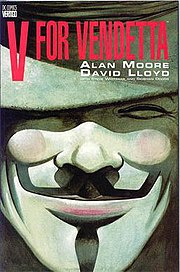
V for Vendetta

V for Vendetta by Alan Moore and David Lloyd
Quality Comics - March 1982 to May 1989
10 issues

In "futuristic" (futuristic at the time, though the event is now in the past) London, the fascist government of Norsefire has control over everyone and has killed all those who were not white, conservative, and straight. London is controlled, until an anarchist named V in a Guy Fawkes mask ignites a revolution when he detonates a bomb in Parliament, setting off fireworks in the shape of a V. A woman named Evey Hammond, who he had saved earlier in the night, watches and comes to help him destroy Norsefire.

How is it that I am reading so many sexist books? Evey Hammond is an extraordinarily passive character, doing next to nothing throughout the course of the graphic novel. The most she does to help V is sit there and gasp when he sets off another one of his bombs. You think that she's becoming a stronger character when she's imprisoned, but it turns out (spoiler alert!)that it was all a trick by V in the first place. She "enjoys" her freedom by becoming the girlfriend of a Scottish gangster and only comes back when V dies. Finally, when V dies, she decides to become the next V, although by now London is already an anarchy, so there's not much she CAN do.(spoiler end) This was ridiculous.

Grade: D

Thursday, August 2, 2012

The Running Man

The Running Man by Stephen King as Richard Bachman
Signet Books - May 1982
219 pages

It is the year 2025, and citizens of Co-Op City are in for a spectacle; a competition known as "The Running Man", where contestants are officially declared to be "enemies of the state" and are hunted down by people known as Hunters, an elite team of hitmen hired by the Games Network. For each hour they survive, the contestant earns $100, and for each Hunter they kill they get another one hundred. If they stay alive for thirty days, they get one million New Dollars, or three million Old Dollars. Ben Richards has a sick daughter and needs money badly. His solution is to go to The Running Man.

Okay, it sounds sort of like The Hunger Games without that silly love triangle, right? Well, that's where you're wrong. It sounds sort of like The Hunger Games without that silly love triangle for about the first half. Then (spoiler alert!)Ben Richards gets into a huge police standoff---must be some kind of Richard Bachman trademark, having a police standoff---in which trades are negotiated, bluffs are made, and ultimately everyone dies. Not joking. This is the end of the book.(spoiler end!) I'm not saying that it was not necessarily a bad book, just not what I was expecting.

Grade: B-

Saturday, July 21, 2012

Firestarter

Firestarter by Stephen King
Viking Press - September 29, 1980
426 pages

Charlie McGee has a power; she can start fires with her mind. This wasn't supposed to happen, of course, but it was a result of her parents. When they were in college, they took part in an experiment for a drug known as "Lot Six" by a goverment agency known as The Shop. When Andy McGee and Victoria Tomlinson participated in this experiment, they retained minor psychic effects. However, that laboratory was where they fell in love. They ended up getting married and had Charlie. Because they both retained minor abilities, Charlie was born with major abilities. The Shop wants Charlie, and they killed Victoria for information. Now Charlie and Andy are on the run.

One problem I had with this book was the fact that a horse named Necromancer was given major significance and then has no end. (Spoiler alert!)Charlie and Andy get captured by The Shop, and they realize that if they don't want Charlie to burn the whole place down, they have to be nice to her. She likes horses, so they show her Necromancer and she learns to ride. When Andy and an officer named Cap plan to escape with Charlie, they decide that she can say she's going to ride Necromancer and then escape. When Charlie burns down the barn, Necromancer escapes and is never seen again. Seems like a waste of forty or so pages about a horse that eventually just runs wild.(Spoiler end) The description could be overpowering at times, but it was okay. Not his greatest, but okay.

Grade: B