Showing posts with label allegory. Show all posts

Wednesday, June 12, 2013

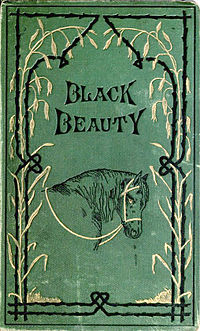
Black Beauty

Black Beauty by Anna Sewell
Jarrold & Sons - November 24, 1877
281 pages

"We call them dumb animals, and so they are, for they cannot tell us how they feel, but they do not suffer less because they have no words."

When his beloved owners are forced to sell him, Black Beauty leaves his life as a young, carefree colt behind him and embarks on a working life of misery. Cruelly treated by his new masters, Anna Sewell rails against animal mistreatment in this poignant tale of a horse whose spirit can not be broken.

Can I express to you how much I love this novel adequately? I don't think so, but I'm certainly going to try.

You may have noticed, loyal blog readers, that this book has been in my "Currently reading" section for quite a while. It's not because I disliked Black Beauty, as the above paragraph clearly shows, but rather because I got bogged down reading several other books.

As a self-described "3/4 animal-rights activist", I wholeheartedly agree with the particular messages that Sewell is trying to send. While I eat poultry and keep a pet, I am fully against the mistreatment of horses, especially by using a whip to drive a horse past its breaking point. Even though I already felt this way before, Black Beauty is enough to change the majority of people.

Grade: A

Tuesday, June 11, 2013

The Jungle Book

The Jungle Book by Rudyard Kipling
Macmillan Publishers - 1894
97 pages

(Spoiler level: Minor)

One thing that I bet you didn't know about The Jungle Book is that it isn't all about Mowgli. There are other stories too. And the Mowgli stories are nothing like the Disney movie. There's no King Louie; the monkeys (or Bandar-log) have no leader because they are uncivilized.

Mowgli's Brothers: A lost human is taken in by wolves and named Mowgli. When the wolf leader Akela is toppled by the lame tiger Shere Khan, Mowgli gains fire from a human village and uses it to scare Shere Khan away. Interesting take on the life of animals in India. Sometimes a little boring. B+

Kaa's Hunting: Mowgli is taken by the Bandar-log, or the evil monkeys, when he's being taught about the jungle by Baloo. I love anything that portrays evil monkeys, and this one is a nonstop adventure the whole way through, unlike the previous one. A

Tiger! Tiger!: Mowgli is found by humans after leaving the wolf pack. When his brother tells Mowgli that Shere Khan has returned, Mowgli comes up with a plan to drive him out for good this time. Sometimes meandering and confusing, it brings a satisfying end to the Mowgli trilogy. B

The White Seal: Kotick, a white seal, searches across the world for a land where humans will not be killing his kind. A great case for the animal cruelty that results from hunting for animal skins. A

Rikki-Tikki-Tavi: A mongoose named Rikki-Tikki-Tavi must kill Nag and Nagaina, a pair of venomous cobras that want to kill the British family he lives with. This is probably one of the more popular stories, and it's simply meh. It's good, but not outstanding. B+

Toomai of the Elephants: Blech. The low point of The Jungle Book. An elephant trainer is taken on the adventure of his life by Kala Nag. Not only does it perpetuate the idea that elephant trainers are good, it focuses very little on Kala Nag's inner thoughts, which is quite a stylistic departure from Kipling's norm. D

Her Majesty's Servants: Animals of the British Army discuss their various lives while a British soldier who understands animals listens in on their conversation. Interesting take, but it could get confusing at times with a lack of "the horse said", etc. A-

Overall Grade: B+

If it weren't for the horrible and ridiculous "Toomai of the Elephants", the grade would be higher, so skip that if you can.

Tuesday, December 18, 2012

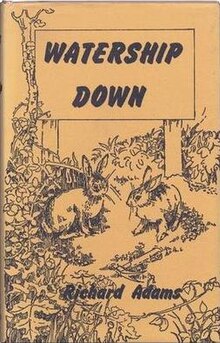
Watership Down

Watership Down by Richard Adams
Rex Collings - November 1972
413 pages plus maps

In the Sandleford Warren, things are peaceful for all the rabbits but Fiver. He has received a horrible vision and tells his brother Hazel immediately. They go to the Chief Rabbit, The Threarah, but he dismisses this and they get chased out by Captain Holly. However, others come with them to find Fiver's high ground, such as the powerful Thlayli (or Bigwig), the clever Blackberry, the quick storyteller Dandelion, the timid Pipkin, the strong Silver, the slow Hawkbit, and the outskirters Speedwell and Acorn. Along the way they encounter other warrens such as Cowslip's Warren and Efrafa, as well as some interesting individuals such as Kehaar the black-headed gull, and search for peace.

I had some reservations going into Watership Down. I knew people that couldn't get past chapter one. However, my doubts quickly vanished as I plunged into the world of the Sandleford Warren. The plot moved at a rapid pace and was filled with suspenseful moments. I truly felt for the characters in one way or another, from loathing Hawkbit, Speedwell, and Acorn, to an instant attachment to Blackberry and the doe Hyzenthlay. While the two main characters Hazel and Fiver weren't particularly outstanding, it was the supporting characters that were wonderful. My personal favorite moments of the stories were the breaks when Dandelion would tell a story of the rabbit trickster El-ahrairah, which were richly crafted, especially The Story of the Trial of El-ahrairah. There were some moments, particularly the very end, where (spoiler alert!)Hazel is invited, upon death, to be part of El-ahrairah's Owsla (or council of high-ranking rabbits) as opposed to the more clever Blackberry, who would be much more fitting for the job of working with the trickster(spoiler end), that I thought could have been handled differently, but it was still a great, engaging read.

Grade: A-

Tuesday, June 19, 2012

'Salem's Lot

'Salem's Lot by Stephen King
Doubleday - October 17, 1975
439 pages

Ben Mears, a popular writer, lived in Jerusalem's Lot when he was young, and left as soon as he could. But now, twenty-five years later, he feels a strange, compelling urge that pulls him back to the Lot. He decides to make his new book about the Marsten House, a house that was owned by a couple whose marriage was ruined in the Depression when Hubert Marsten killed his wife and then himself. Now, after all this time, the house has been purchased by two men named Barlow and Straker, who are not what they seem.

This novel began extremely slowly. I knew that something was going to happen when Ben came back as well as when the house was found to be purchased, but the vampire plot didn't surface until much later in the story, when (spoiler alert!)Danny Glick, who died following his little brother Ralphie being taken in the woods, rose from the grave and killed the gravedigger(spoiler end) that the real action began. Afterwards, it moved quickly. Sometimes, though, it seemed like King was looking for an easy way out, like when a vampire who was invited in was repelled by the invitation being revoked, something that seems too easy to do. Some of the many viewpoints got confusing or I did not care about. There were also many "crash test dummies", as mentioned in my Mockingjay review. As for characterization, some characters felt like archetypes while others were developed. I would be interested in seeing how Ben Mears would have written this story.

Grade: B

Thursday, May 31, 2012

Bambi, A Life in the Woods

Bambi, A Life in the Woods by Felix Salten
Paul Zsolnay Verlag - 1923 (English in 1928)
192 pages (1988 Aladdin edition)

Bambi, a roe deer buck, is born in a thicket in a forest, where he doesn't know it yet, but he is the son of the old Prince, a stag who rules over the forest. Salten follows the young prince through is life, where death abounds, but there is also beauty and grace.

Let me begin by saying that this is not a novel for the faint of heart. I am sure that many have seen the Disney animated movie Bambi on which this was based, but his is a much, much darker book. Bambi's mother (spoiler alert?) dies in the book as well as the movie (spoiler end?) but many other characters face a grim end, including but not limited to (spoiler alert!) Gobo, Bambi's cousin, a pheasant, the old Prince, and a fox. (spoiler end) This is a quick-paced book that was greatly enjoyable to read. Unlike other classics, because it uses animal allegory, it never becomes old. Men still use guns and like to go out hunting; that's the only thing that may have changed in almost 90 years. Some deaths I thought were unnecessary, but Salten seemed to have really liked going out of his way to explain the gruesomeness of humans when they destroy nature. If he were still alive, I would tell him Brava!

Grade: A-

Sunday, May 6, 2012

Animal Farm: A Fairy Story

Animal Farm: A Fairy Story by George Orwell
Secker and Warburg - August 17, 1945
112 pages

This is a classic tale of humanity awash in totalitarianism. A farm is taken over by its overworked, mistreated animals. With flaming idealism and stirring slogans, they set out to create a paradise of progress, justice, and equality. First published during the epoch of Stalinist Russia, today it is clear that wherever and whenever freedom is attacked, and under whatever banner, the cutting clarity and savage comedy of Orwell's masterpiece is a message still ferociously fresh.

(Spoiler level: Minor/nonexistent)


I have read this book more times than I can count. It is my favorite novel. I have done all kinds of projects about this novel. I converted excerpts of this novel into different fonts to see which ones were more readable. I have an Animal Farm t-shirt from Out of Print Clothing (look it up, it's awesome). I quote it frequently. I sing "Beasts of England" when I'm bored. Some people I know think that this obsession is unhealthy, but I don't care.

The first time that I read this book was at a very young age when I thought that it was just a story about animals. The second time I was a few years older and knew that it was supposed to be about Stalinist Russia, but I was still pretty young and ended up overthinking it and searching for a greater meaning that I couldn't find when I was younger. Then I saw the 1959 cartoon animated movie and thought that I really couldn't remember that much about it, so I went back and enjoyed it again, this time being able to make the connections. A time after that I read it to enjoy it as a story, just like when I was six. Now every time I have insomnia I read at least half of it, which really isn't too much when you think about it.

That's what's so great about Animal Farm. You can read it as an animal story and as a metaphor. Not to mention, you can find multiple metaphors in it, as books about the novel show. Yes, it's about Stalinist Russia, but think of the treatment of the female animals on the farm compared to the male animals! You can appreciate Orwell's fiction writing as well as his satire.

As I said, it is truly my favorite novel.


Grade: A+