Showing posts with label humor. Show all posts

Saturday, August 24, 2013

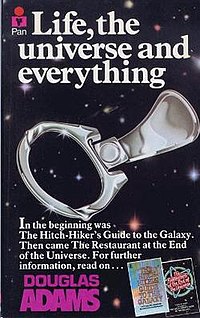
Life, the Universe and Everything

Life, the Universe and Everything by Douglas Adams
Pan Books - 1982
160 pages

The unhappy inhabitants of planet Krikkit are sick of looking at the night sky above their heads--so they plan to destroy it. The universe, that is. Now only five individuals stand between the killer robots of Krikkit and their goal of total annihilation.
They are Arthur Dent, a mild-mannered space and time traveler who tries to learn how to fly by throwing himself at the ground and missing; Ford Prefect, his best friend, who decides to go insane to see if he likes it; Slartibartfast, the indomitable vice president of the Campaign for Real Time, who travels in a ship powered by irrational behavior; Zaphod Beeblebrox, the two-headed, three-armed ex-president of the galaxy; and Trillian, the space cadet who is torn between a persistent thunder god and a very depressed Beeblebrox.
How will it all end? Will it end? Only this stalwart crew knows as they try to avert "universal" Armageddon and save life as we know it--and don't know it!

This one is different than the other two. The plot is about Armageddon by the robots of Krikkit from the beginning to end. It ambles in the middle, but ultimately it sticks with one plot the whole way through, which saves a lot of trouble.

The book took me only a couple of days to read, but it makes it difficult to review. Unlike most series that have wild ups and downs (The Last Werewolf trilogy), the Hitchhiker's "trilogy" stays more and more consistent.

Grade: A-

Tuesday, August 6, 2013

The Restaurant at the End of the Universe

The Restaurant at the End of the Universe by Douglas Adams
Pan Books - January 1, 1980
208 pages

Facing annihilation at the hands of the warlike Vogons is a curious time to have a craving for tea. It could only happen to the cosmically displaced Arthur Dent and his curious comrades in arms as they hurtle across space powered by pure improbability and desperately in search of a place to eat.
Among Arthur's motley shipmates are Ford Prefect, a longtime friend and expert contributor to the Hitchhiker's Guide to the Galaxy; Zaphod Beeblebrox, the three-armed, two-headed ex-president of the galaxy; Tricia McMillan, a fellow Earth refugee who's gone native (her name is Trillian now); and Marvin, the moody android who suffers nothing and no one very gladly. Their destination? The ultimate hotspot for an evening of apocalyptic entertainment and fine dining, where the food (literally) speaks for itself.

This is the second book out of five in the Hitchhiker "trilogy" written by Adams himself. Fortunately, I liked it just as much as the first one. It starts with a laugh as the entire computer system on the ship shuts down because it needs to figure out how to make tea, or "the taste of dried leaves boiled in water with milk squirted out of a cow."

This one's plot was a little less coherent than its predecessors while it was going on, but I think that it tied together better at the end and more of an ending, which is more than I can say for the first book. However, that means that it wasn't set up particularly well for a third book, which is bad considering there are five books written by Adams and one more by Eoin Colfer.

This installment is less about Arthur and Ford than it is Zaphod and Marvin; while Zaphod wasn't exactly my favorite character in Hitchhiker's, Marvin was one of the greatest robots, if not one of the greatest speculative fiction characters, I have ever seen. Once again he uses his pessimism to kill off other technology, this time by angering a tank into shooting around the floor it's standing on and falling through to the ground, where it breaks.

Zaphod also comes more into his own in this part, although he's still not anywhere near being my favorite character. Here's to hoping Ford and Marvin go on an adventure in book 3!

Grade: A-

Tuesday, July 16, 2013

The Smart Aleck's Guide to American History

The Smart Aleck's Guide to American History by Adam Selzer
Delacorte Press - December 22, 2009
336 pages

Do you know America? No, I mean, do you REALLY know America? Would you recognize John Adams in a lineup? Can you identify any presidents between Lincoln and Roosevelt?
Hmm. I thought so.
Well, you really need this book.
Not only will it improve your sorry historical knowledge, it will crack you up, and give you material to throw your teachers off-balance for entire class periods. Identify their lies! Point out their half-truths! And possibly, just possibly, gain some extra credit for yourself.

For the record, the presidents between Lincoln and Roosevelt are Andrew Johnson, Ulysses S. Grant, Rutherford B. Hayes, James Garfield, Chester Alan Arthur, Grover Cleveland, Benjamin Harrison, Grover Cleveland again, and William McKinley. I knew that before even opening the book; I've actually memorized the presidential order; it just takes me a second to think of the number. Usually it's in some relation to the assassinated ones (16, 20, 25, and 35, but that's if you count Cleveland twice).

I found out about this book when I was doing some research into the poem written by Charles Guiteau (the assassin of Garfield; see Destiny of the Republic) right before his execution, "I am Going to the Lordy". The book is presented in textbook style, so there are questions after every chapter; there was an "Extra Credit" section where you had to say what Guiteau's poem sucked more than, such as being a capitalist at Leon Czolgosz's dinner parties.

I was immediately sucked into the book within minutes of opening it; the pictures and sidebars especially are humorous, as they used only public domain pictures. This resulted in a picture of four dots being an overhead shot of the Beatles, and James Monroe as a substitution for Marilyn Monroe. It also teaches you actual history, such as how Victoria Woodhull tried to run for president when women couldn't vote, she wasn't even thirty-five, and she was in prison on election day.

It's not even just for kids or teenagers; anyone can enjoy it, even if they know all of the history. For example, I already knew about Charlie Guiteau, but the sidebar on him was still great because of the take that they used (not unlike my own when I'm describing the assassination to people).

Grade: A

The Teleportation Accident

The Teleportation Accident by Ned Beauman
Sceptre - July 19, 2012
357 pages

HISTORY HAPPENED WHILE YOU WERE HUNGOVER
When you haven't had sex in a long time, it feels like the worst thing that is happening to anyone anywhere. When you're living in Germany in the 1930s, it probably isn't. But that's no consolation to Egon Loesser, whose carnal misfortunes will push him from the experimental theatres of Berlin to the absinthe bars of Paris to the physics laboratories of Los Angeles, trying all the while to solve two mysteries: whether it was really a deal with Satan that claimed the life of his hero, the great Renaissance stage designer Adriano Lavicini; and why a handsome, clever, charming, modest guy like himself can't, just once in a while, get himself laid. From the author of the acclaimed Boxer, Beetle comes a historical novel that doesn't know what year it is, a noir novel that turns all the lights on, a romance novel that arrives drunk to dinner, a science fiction novel that can't remember what "isotope" means, a stunningly inventive, exceptionally funny, dangerously unsteady and (largely) coherent novel about sex, violence, space, time, and how the best way to deal with history is to ignore it.
LET'S HOPE THE PARTY WAS WORTH IT

You know those summaries of books where you really wonder if whoever was tasked with doing that truly read the book or if they just skimmed it and decided to come up with a wild hook to get people into the novel? Well, I think that's what happened here. Maybe thirty pages are devoted to the Lavicini mystery, and it isn't even about a deal with Satan, It's about whether the "Teleportation Accident" of 1679 was actually an accident.

So, the book. Not one of my favorites. I think it might have been my fault, because I was thinking to myself one day that I had read so many good books, and I would just love to rant and rant about how horrible a book is. Unfortunately, I haven't gotten something that horrendous. In fact, I've gotten stuff I've forced myself to finish, felt bad about finishing, but didn't want to go crazy ranting about it like I had Mockingbird.

I simply didn't care about any of the characters, which was good considering how many of them popped up and then disappeared. In addition, the last few chapters skip about ten years, and you're expected to understand everything that happened in those ten years. The plot isn't a clear, defined one, much like The Dead Zone; instead it aimlessly wanders around, pausing at times to poke at something that might become sort of a story before the author gets bored with it and throws it away. He even grew bored with the era of the 1930's/40's, so near the end he just skipped a decade per chapter and expected you to know what was going on.

I don't know why I forced myself to finish this. Maybe I thought that it would get better? Whatever the answer is, it didn't get better. There's no plot, just some meandering stories that happen to feature an unlikable protagonist and his interactions with unlikable people. I would give it an F, but then I remind myself of Mockingbird.

Grade: D-

Tuesday, July 9, 2013

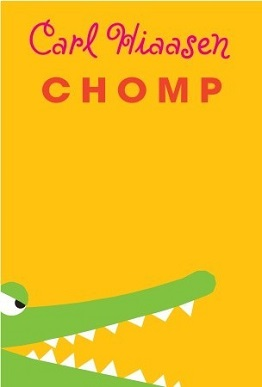
Chomp

Chomp by Carl Hiaasen
Alfred A. Knopf - March 27, 2012
304 pages

Wahoo Cray lives in a zoo. His father is an animal wrangler, so he's grown up with all types of creatures in his backyard. The critters he can handle, but his father is another story.
When his father takes a job for a reality TV show called Expedition Survival!, Wahoo has to do a bit of wrangling to keep his father from killing the star, boneheaded Derek Badger, before the shoot is over. Things keep getting more and more complicated as Derek insists on using wild animals in his stunts. Then there's Wahoo's new shadow Tuna, a girl with an abusive father who needs somewhere to hide out.
It's anyone's guess who will actually survive Expedition Survival!...

I had to cut a paragraph out of that description because it pretty much gives away a chunk of the story due to the type of lousy publicity that Hiaasen has that decides to spill out over half the novel in a 3 1/2 paragraph description.

I love Carl Hiaasen, especially his YA books about the Everglades: Hoot, Flush, and Scat. I've been waiting more than a few years for the next one, and I can tell you that Chomp sufficiently meets my expectations. Instead of being about saving a species, like burrowing owls or Florida panthers, this is about a  broke wildlife wrangler and his son who take a job for a "reality" show to pay off their debt.

In the usual Hiaasen way, Chomp is enough to make you laugh out loud on several occasions and is filled with nearly caricature characters, but it also has elements that I don't remember seeing in previous YA Hiaasen Everglades books: actual suspense and danger where you legitimately worry about the lives of the characters.

Ladies and gentlemen, what can I say? Hail...to...Hiaasen! (If you don't get that reference, brush up on your controversial musicals)

Grade: A

Saturday, April 20, 2013

Slaughterhouse-Five

Slaughterhouse-Five by Kurt Vonnegut
Delacorte - 1969
186 pages

Kurt Vonnegut's absurdist classic Slaughterhouse-Five introduces us to Billy Pilgrim, a man who becomes unstuck in time after he is abducted by aliens from the planet Trafalmadore. In a plot-scrambling display of virtuosity, we follow Pilgrim simultaneously through all phases of life, concentrating on his (and Vonnegut's) shattering experience as an American prisoner of war who watches the firebombing of Dresden.

Honestly, at first, I was a little confused reading this novel. That's because chapter one is more like an introduction to the novel, where Vonnegut describes how he poured his life into this novel, but it was truly terrible and jumbled. Vonnegut inserts himself into two more situations, one where he is suffering the consequences of food poisoning and suggests that his brains may be coming out, and again where he says "Oz" as the characters are going to Dresden.

That being said, once it got into the actual novel, it turned wonderful. I was glad to see that it was supposed to be funny, because there were times I disturbed people around me with my laughing. For example, the protagonist Billy Pilgrim is reading the Bible and thinks that the message of the Gospels is: "If you are going to kill someone, make sure it is someone who is not well-connected."

In the beginning, I felt that Slaughterhouse-Five was a little too jumpy with the time-travelling, going from World War II to Pilgrim's childhood to visiting his mother in the nursing home in spans of only a few paragraphs, but then it finally levelled out to focus mainly on its topic: the firebombing of Dresden in World War II.

While I was a bit hesitant to pick up World War II fiction, as it's not exactly my favorite period of historical fiction (that one's actually tough: maybe Black Death in England, the Industrial Revolution, World War I, or Anglo-Saxon times), it is easily wonderful.

Grade: A-

Saturday, February 23, 2013

The Hitchhiker's Guide to the Galaxy

The Hitchhiker's Guide to the Galaxy by Douglas Adams
Pan Books - October 12, 1979
180 pages

Arthur Dent is a completely unremarkable human that is living in a completely unremarkable town on a completely unremarkable Thursday. He wakes up to find that his house is about to be demolished for a bypass. Naturally, Arthur lies down in front of the bulldozers so that they can't go anywhere. Soon his friend Ford Prefect comes and invites him for a drink, hypnotizing the man in charge of demolition to take Arthur's place. Ford then calmly explains to them that he is an alien stranded on Earth in his quest to update The Hitchhiker's Guide to the Galaxy, an early form of the ebook. Earth is about to be destroyed by a race called the Vogons, and just before they disintegrate, Arthur and Ford hitch a ride on the ship.

Ah, yet another short novel. At least this one comes at the beginning of a series, so it will add up to be longer in the long run. And I assure you that I will be reading the next books of the series. This cult phenomenon deserves a widespread audience. In one of my favorite parts of the novel, (spoiler alert! This is the turning point of the book, so don't read unless you really don't care!)Marvin the paranoid android, a chronically depressed robot, kills a ship by telling it about his world views. The ship kills itself in utter depression.(spoiler end) This work is wholly clever and imaginative.

Grade: A

The High-Skies Adventures of Blue Jay the Pirate

The High-Skies Adventures of Blue Jay the Pirate by Scott Nash
Candlewick - September 25, 2012
368 pages

Captain Blue Jay is the captain of the Jolly Robin and leader of a band of fearsome pirates who fly in an airship across Thrushland, pillaging. Captain Blue Jay has always had an affinity for eggs, and when he captures one that hatches into a Brantas goose, a species long believed to have magical powers and even be a god. Blue Jay can use this to his advantage when he faces off against the treacherous crow Teach and his brother Bellamy.

My chief complaint with this novel is how short it is. It's not just the 368 pages; the font is large, there is great spacing between them and frequent pictures. If this had been longer, it could have been thrilling. However, I'm going to have to label it as merely "above average". While I have to disagree with the use of crows as antagonists, I'm pleased with the choice of having a blue jay antihero, and of course I can't disagree with the use of anthro at all in any work, from short story to novel. Not to mention, as much as it shortened the page length, the pictures were stunning.

Grade: B+

Thursday, May 31, 2012

Diary of a Wimpy Kid

Diary of a Wimpy Kid series by Jeff Kinney
Scholastic Publishing/Amulet Books - April 1, 2007-present
217 pages (Cabin Fever 223)

Greg Heffley is a middle school boy whose mother gets him a journal that accidentally says "Diary" on it. That's how it starts, and Greg chronicles his progress through middle school (and I assume high school, though there was no graduation) in the diary all while hoping nobody finds out about what it says on the cover.

Let me just say that I got on this trend before it was really popular. I know a lot of people say that, but it's true. It was right after the first book came out that I sat down in a bookstore and started reading, and I thought to myself, "Hey, this is pretty funny!" It took a little while for everyone else to get on the trend. I don't read a lot of humor books, and so this was something different to me. Also, most humor on the market is just pictures, like Cake Wrecks or Passive-Aggressive Notes. This was humor with a plot. I have some problems with the series, as Kinney tries to make sure that any kids reading this don't have their hopes and dreams crushed, but what eighth grader really believes in Santa anymore? The plot sometimes feels a little thin at times, but these books zip right along. It's almost a waste of money with how fast you finish them, but then you read them again...and again...and again.

Cumulative Grade: B+