Showing posts with label nonfiction. Show all posts

Tuesday, July 16, 2013

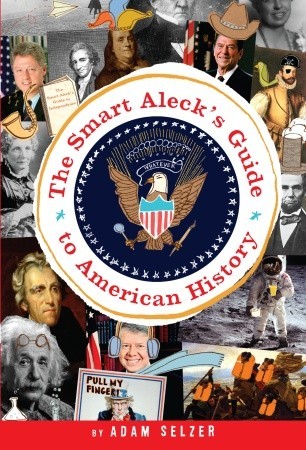
The Smart Aleck's Guide to American History

The Smart Aleck's Guide to American History by Adam Selzer
Delacorte Press - December 22, 2009
336 pages

Do you know America? No, I mean, do you REALLY know America? Would you recognize John Adams in a lineup? Can you identify any presidents between Lincoln and Roosevelt?
Hmm. I thought so.
Well, you really need this book.
Not only will it improve your sorry historical knowledge, it will crack you up, and give you material to throw your teachers off-balance for entire class periods. Identify their lies! Point out their half-truths! And possibly, just possibly, gain some extra credit for yourself.

For the record, the presidents between Lincoln and Roosevelt are Andrew Johnson, Ulysses S. Grant, Rutherford B. Hayes, James Garfield, Chester Alan Arthur, Grover Cleveland, Benjamin Harrison, Grover Cleveland again, and William McKinley. I knew that before even opening the book; I've actually memorized the presidential order; it just takes me a second to think of the number. Usually it's in some relation to the assassinated ones (16, 20, 25, and 35, but that's if you count Cleveland twice).

I found out about this book when I was doing some research into the poem written by Charles Guiteau (the assassin of Garfield; see Destiny of the Republic) right before his execution, "I am Going to the Lordy". The book is presented in textbook style, so there are questions after every chapter; there was an "Extra Credit" section where you had to say what Guiteau's poem sucked more than, such as being a capitalist at Leon Czolgosz's dinner parties.

I was immediately sucked into the book within minutes of opening it; the pictures and sidebars especially are humorous, as they used only public domain pictures. This resulted in a picture of four dots being an overhead shot of the Beatles, and James Monroe as a substitution for Marilyn Monroe. It also teaches you actual history, such as how Victoria Woodhull tried to run for president when women couldn't vote, she wasn't even thirty-five, and she was in prison on election day.

It's not even just for kids or teenagers; anyone can enjoy it, even if they know all of the history. For example, I already knew about Charlie Guiteau, but the sidebar on him was still great because of the take that they used (not unlike my own when I'm describing the assassination to people).

Grade: A

Tuesday, June 11, 2013

Homer's Odyssey

Homer's Odyssey: A Fearless Feline Tale, or How I Learned About Love and Life with a Blind Wonder Cat by Gwen Cooper
Delacorte Press - August 25, 2009
287 pages

Once in nine lives, something extraordinary happens...
The last thing Gwen Cooper needed was another cat. She already had two, not to mention a phenomenally underpaying job and a recently broken heart. Then Gwen's veterinarian called with a story about a three-week-old eyeless kitten who'd been abandoned. It was love at first sight.

{Spoiler level: Minor)

I'll tell you right away that if you are a cat person and read this, your immediate impulse after closing the book in completion will be to run out to your nearest humane society and adopt a special needs cat. It doesn't even have to be eyeless; it can be plain blind, or three-legged, or deaf, or even those little two-legged cats that have to have wheels to move around. So just keep that in mind when you're reading; resist the urge to get a special needs cat on impulse.

Onto the story! Now, you may have noticed that it said "three-week-old eyeless kitten". Homer had a horrible eye infection and was brought into the vet's office. The couple who brought him showed interest in keeping him until the vet said that she was going to have to remove his eyes if he wanted to live. They no longer wanted him. The vet performed the operation and stitched up his eyes. She then asked around if anyone wanted the cat. Gwen Cooper didn't want one, but she came over to see him and then adopted him.

You have to care something about cats to really appreciate Homer's Odyssey, or you'll find yourself without any kind of feeling for the blind, eyeless kitten. I personally laughed and cried at all of Homer's exploits and what he did for Gwen and the other cats he lived with.

Another thing that you have to know is that the novel may make more sense to you if you actually live with cats. One angry Amazon reviewer said that he felt it was illogical that Gwen would know what Homer was trying to say from his meows. I've owned a cat for nearly five years now, I know what she's trying to say most of the time. My cat was also one when I got her, and so if you raise a cat from its very kittenhood, you'll have an even closer bond and know what everything's about.

So the bottom line is: if you love cats and have owned one at least sometime in your life, you will find this book wonderful, but if you either are indifferent to cats or have never owned one, you may not appreciate it. And if you think cats come from Satan, why would you even pick up this book? The cat takes up three-quarters of the cover!

Grade: A

Saturday, April 13, 2013

Destiny of the Republic

Destiny of the Republic: A Tale of Madness, Medicine, and the Murder of a President by Candace Millard
Doubleday - September 20, 2011
339 pages

President James Abram Garfield was the twentieth president of the United States and a dark horse who never wanted to be president. He was a relatively young man, forty-nine when inaugurated, and liked hugs and reading. Meanwhile, Charles J. Guiteau was a conman who was kicked out of the Oneida community for his arrogance and published a plagiarism of the community's founder's book, calling his version The Truth. Guiteau survived a shipwreck and decided that God had singled him out for something special. When Garfield is inaugurated, Guiteau asks to be ambassador to first Austria and then France. When Garfield and Secretary of State James G. Blaine refuse him this, Guiteau realizes that God singled him out to kill the president.

I first got an interest in the Garfield assassination when I saw the musical Assassins by Stephen Sondheim, which is about, you guessed it, assassins. Guiteau was almost like the fop of the musical, a bold figure who believed that the Garfield administration said he could be ambassador to France and who eventually cakewalks up to the gallows singing a song he penned on death row. Interestingly enough, the song that he sings up there, "I Am Going to the Lordy", he actually did write on death row! I had not learned much about Garfield from the musical, and yet I grew to sympathize with the man who never wanted the job that ended up killing him all while laughing at Guiteau's attempt to kill the president when he was at a sermon, but Guiteau was so enraged at the preacher's ideas he yelled out and then ran away. The book is informative, humorous, and engaging.

Grade: A

Friday, November 23, 2012

Silent Spring

Silent Spring by Rachel Carson
Houghton Mifflin - September 27, 1962
367 pages (approx.)

I apologize for the "approximate" page numbers. I could not get a specific number for the first edition, so I relied on the number that was in the copy I got from the library. I'm also going to apologize for the picture, another issue I had with first editions. This is what happens when I review an older book. Anyway, let's get right to the plot. Carson believes that uncontrolled and unexamined pesticide use is killing and harming much more than the intended targets of weeds and insects, going so far as to damage whole ecosystems. The title is suggesting a spring when so many birds have died that there is no singing.

Let me get straight to the point: this book was absolutely wonderful. Even when we are coming into the fiftieth anniversary of the publication of Silent Spring and the pesticides mentioned have long been stopped in the United States, the book is filled with insight and information. Carson does not simply wag her finger at those who use DDT, dieldrin, aldrin, endrin, toxaphene, and heptachlor. She instead suggests better methods that I found extremely interesting, from introducing natural predators of invasive species to the sterilization of pests. Stories of birds, cats, and small children dying as a result of these chemicals the government brushed off as "harmless" are like a car crash: horrifying and yet terribly intoxifying. Rachel Carson is not a hysterical woman; she set out to make the world a better place.

Grade: A

Saturday, October 27, 2012

Chasing Lincoln's Killer

Chasing Lincoln's Killer by James L. Swanson
Scholastic Press - February 1, 2009
208 pages

The young adult version of Swanson's 2006 work Manhunt: The 12-Day Chase for Lincoln's Killer, this book starts out with the following notice: "This story is true. All the characters are real and were alive during the great manhunt of April 1865. Their words are authentic and come from original sources: letters, manuscripts, trial transcripts, newspapers, government reports, pamphlets, books and other documents. What happened in Washington, D.C., that spring, and in the swamps and rivers, forests and fields of Maryland and Virginia during the next five days, is far too incredible to be made up."

Chasing Lincoln's Killer may be a book for young adults adapted from a book for adults, but it succeeds in possibly one of the greatest challenges of this feat; not talking down to the younger audience that it is now for. Another successful endeavor in Chasing Lincoln's Killer is the way that it is presented; instead of being bogged down with minute details and various alternate ideas, it is presented in the same manner as a fictional thriller. As this is nonfiction, I cannot say anything on "plot", "characters", or "setting", but the subject choice is excellent matter, as many more books are devoted to the time leading up to Lincoln's assassination than books devoted to the aftermath of Lincoln's assassination.

Grade: A-

Thursday, August 2, 2012

No Animals Were Harmed: The Controversial Line Between Entertainment and Abuse

No Animals Were Harmed: The Controversial Line Between Entertainment and Abuse by Peter Laufer, Ph.D.
Lyons Press - October 18, 2011
272 pages

Animals have been used and abused for centuries, even millenia. Everyone has their own opinion: circus ringleaders insist that no animals are abused in their work, while animal rights advocates plead to stop it. So the question is, what is use and what is abuse? Is it black and white, or a gray line? Is there any kind of use that isn't abuse? If there is some use that isn't abusive, then what is it? What's okay and what's not? Homing pigeons? Sled dogs? Dancing bears? Elephant polo? Circuses? Cockfights and dogfights? Slaughterhouses? Horseback riding? Keeping a pet?

This is the first nonfiction book that I have gotten to review, and I am glad that it is a good one. I've always had opinions about the difference between use and abuse for animals, and so I wanted to see what they would have to think. One of the best things about the book, in my opinion, is that it doesn't say, like any other book, magazine, newspaper, or website about this topic, what is right and what is wrong. Instead, it asks you to think of what's right and what's wrong. Peter Laufer goes around the United States and Puerto Rico asking people who work with animals what they think. Obviously, cockfighters think that cockfighting isn't abuse and slaughterhouse owners think that eating meat isn't abuse. But they also pose questions for you. The one thing I wholly disagree with is a militant vegan who envisioned a world without any human interaction with animals. If an emaciated, dehydrated animal with a broken bone came to your door, would you turn it away because humans shouldn't interact with animals?

Grade: A